
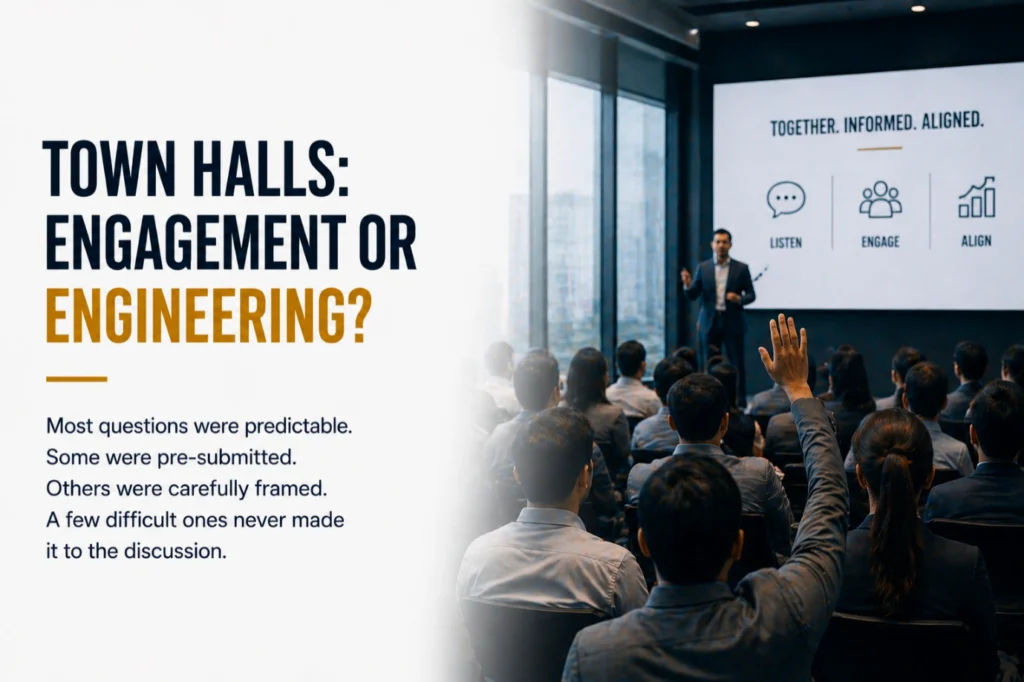
The town hall was well planned.
Slides were polished. Messaging was aligned. The leadership team was present.
It looked like a perfect engagement platform.
Employees attended. Questions were invited.
But most questions were predictable.
Some were pre-submitted. Others were carefully framed. A few difficult ones never made it to the discussion.
The session ended on time. Applause followed.
From the outside, it was successful.
Inside, it felt incomplete.
Employees had heard the leadership.
But they hadn’t felt heard.
Over time, participation became passive. Attendance remained—but engagement dropped.
People stopped asking questions—not because they didn’t have any, but because they didn’t expect real answers.
The format continued. The intent remained.
But trust quietly declined.
Town halls don’t fail because of structure.
They fail when authenticity is missing.
Engagement cannot be engineered.
It must be experienced.
In organisations where leaders are accessible, even informal interactions create impact.
But where distance exists, even the most structured platforms feel staged.
Because in the end, employees don’t measure communication by frequency or format.
They measure it by honesty.