
O3 Digital Theory
Social media has fundamentally altered the nature of crises.
What once unfolded over hours—or even days—now escalates within minutes. A single post can trigger widespread attention, shape public perception, and place organisations under immediate scrutiny. More importantly, these crises no longer develop in isolation. They unfold in public, in real time.
In such an environment, the first response is no longer internal deliberation. It is external acknowledgement.
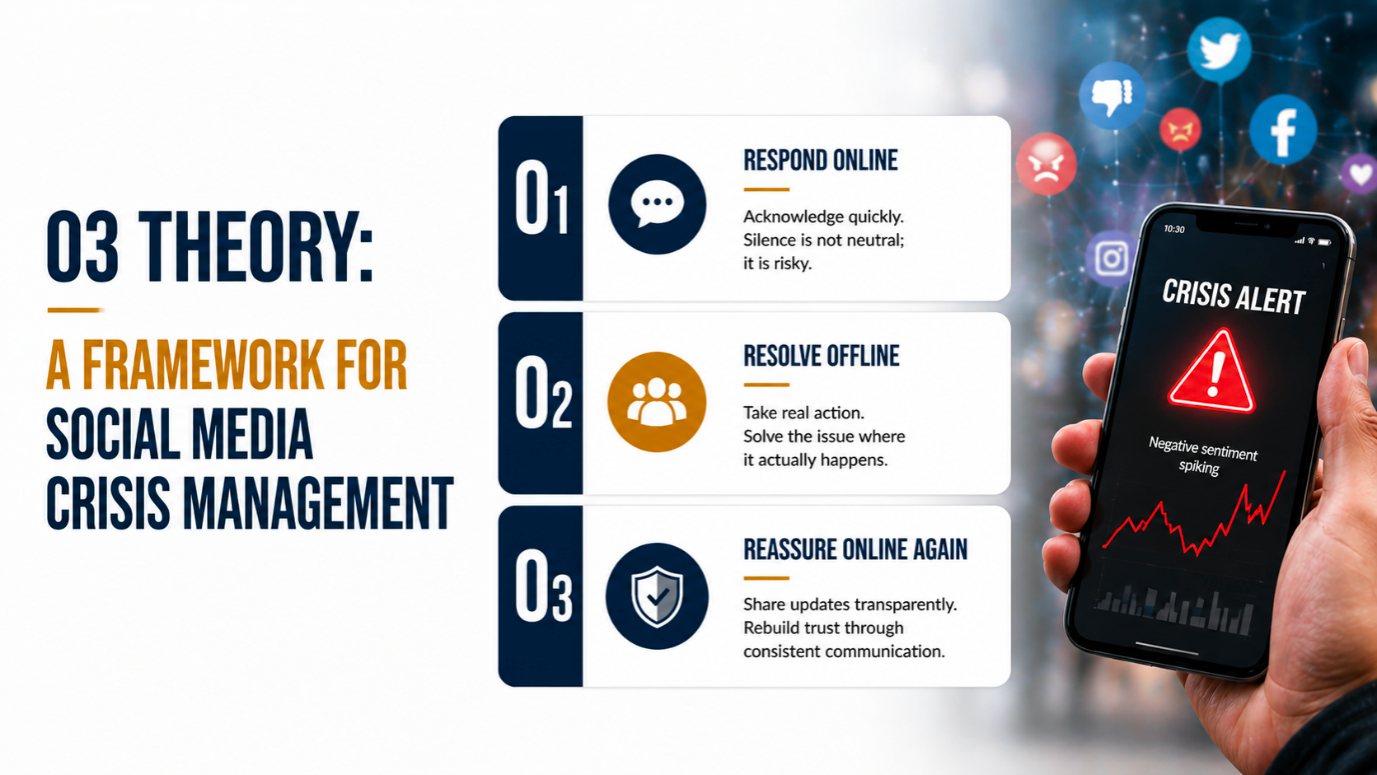
This shift calls for a structured approach to crisis communication—one that is both simple and decisive. The O3 Theory offers such a framework, built on a three-step loop: Online, Offline, Online again.
The first step is online acknowledgement.
When a concern emerges on social media, it must be addressed on the same platform. Silence is rarely neutral—it is often interpreted as indifference. Even when complete information is not available, a timely acknowledgement signals accountability and presence.
The second step is offline resolution.
While crises begin online, they cannot be resolved there. Social media is designed for visibility, not for depth. Meaningful resolution requires context, dialogue, and often confidentiality. Moving the conversation to direct channels—calls, messages, or emails—allows organisations to engage constructively and prevent unnecessary escalation.
The third step is returning online to close the loop.
Resolution, if kept private, remains incomplete. Communicating closure publicly is essential—not just to resolve the issue, but to demonstrate responsibility. This final step is where trust is rebuilt and credibility is reinforced.
At its core, the O3 Theory is not complex. Its strength lies in discipline.
In many organisations, crisis response tends to be reactive—driven by urgency but lacking structure. The absence of a clear framework often leads to delays, fragmented messaging, and loss of narrative control. The O3 model ensures consistency, clarity, and speed—three elements that define effective communication in high-pressure situations.
Crisis management today is no longer limited to resolving issues. It is about managing perception in real time. Every response contributes to the narrative, and every narrative shapes trust.
As digital ecosystems continue to accelerate the spread of information, organisations must adapt not just in capability, but in mindset.
Because in the age of social media, how a brand responds is just as important as what it resolves.