
“The treasury is based on mining,” wrote Chanakya in the Arthashastra—establishing, over two millennia ago, the central role of mineral resources in economic strength.
The idea of sustainability is not new—and notably, it has its origins in resource extraction. In 1713, Hans Carl von Carlowitz introduced Nachhaltigkeit in the context of managing timber for mining, arguing that resources must be used in a way that ensures continuity. It took nearly 275 years for this idea to gain global prominence through the United Nations report Our Common Future. Yet, more than three centuries later, the core challenge remains unresolved—sustainability is still positioned as regulation, not responsibility.
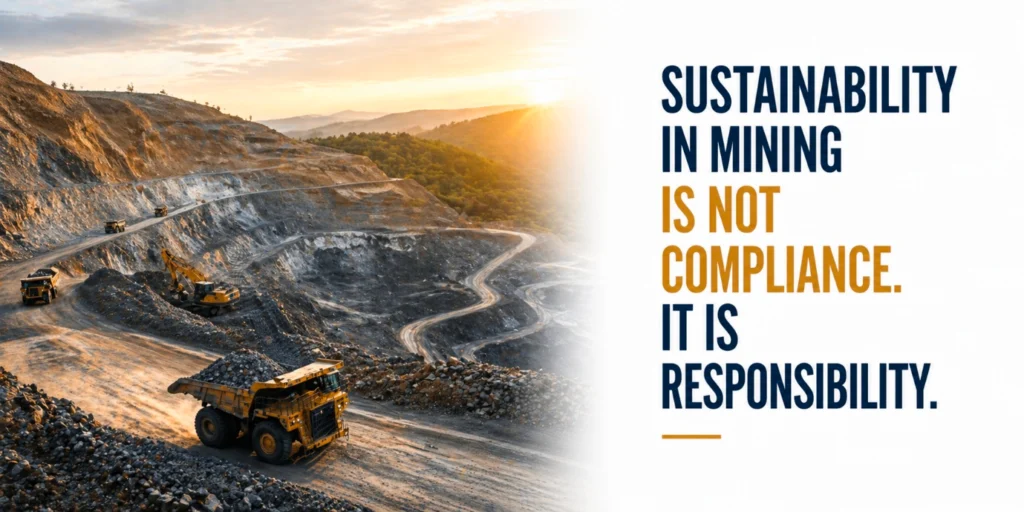
Sustainability in the mining and metals sector, shaped by global frameworks of the United Nations, has evolved into a structured, measurable, and reportable function. Today, companies disclose emissions, water usage, land reclamation, and ESG metrics with increasing rigour. The mining industry has also come a long way in addressing stringent compliances—what were once evolving norms are now embedded in everyday operations. Yet, despite this progress, sustainability in mining continues to operate largely within the comfort zone of compliance rather than the discipline of consequence. For a sector that sits at the very foundation of industrial value chains, this distinction is critical.
At a mandatory level, mining companies are required to undertake Environmental Impact Assessments, secure clearances, implement mine closure plans, manage tailings, and comply with environmental and safety norms. These define the industry’s license to operate. However, they are designed to ensure compliance within defined boundaries, not to fully account for broader ecological and social consequences.
Global evidence highlights the scale of this challenge. The industrial sector accounts for about 37% of global energy demand, according to the International Energy Agency, with mining and metals forming a significant share. At the same time, declining ore grades are increasing resource intensity. Copper ore grades have declined by around 30% over the past 15 years, requiring more energy, water, and earth movement for the same output.
This trend extends across minerals such as zinc, nickel, cobalt, lead, silver, iron ore, and bauxite. As high-grade deposits are depleted, future supply is increasingly dependent on lower-grade and more complex ores, leading to higher processing intensity and greater environmental footprint per unit of output. India, as one of the world’s largest producers of coal and iron ore, sits at the centre of this transition.
The implication is clear: More minerals must be extracted and processed to sustain the same level of output—intensifying environmental impact even as efficiency improves.
At the same time, minerals are fundamental to life and development. Without minerals, there is no infrastructure, no energy systems, no industries, and no modern civilisation. The mining and metals sector underpins economic growth and supports millions of livelihoods, generating employment for both skilled and unskilled labour, particularly in resource-rich regions.
This brings us to a critical inflection point. If compliance is now embedded, the question is whether we must revisit these frameworks. Are they sufficient in the context of rising demand and declining resource quality? Or must they evolve further—becoming more stringent, more contextual, and more aligned with the balance of the five fundamental elements – air, earth, water, space, and fire?
Sustainability in mining cannot remain confined to regulatory thresholds or site-level metrics. It must expand to reflect system-level accountability—from regional water use to progressive land restoration, from value creation per unit of mineral to long-term community integration. A mining operation may achieve water neutrality within its boundary, yet operate in a water-stressed region—highlighting the gap between compliance and real impact.
Beyond all frameworks lies a deeper test. What happens in the absence of regulation? Sustainability is not only a regulatory requirement—it is a function of leadership. It is defined not only by what is measured, but by what is chosen.
India stands at a critical point in this transition. As demand for minerals rises, the mining sector will play a central role in economic growth. This presents an opportunity to move beyond compliance-driven approaches and adopt impact-oriented frameworks grounded in accountability.
The future of mining will not be defined by compliance alone, but by the courage to take responsibility—especially when no one is watching.