
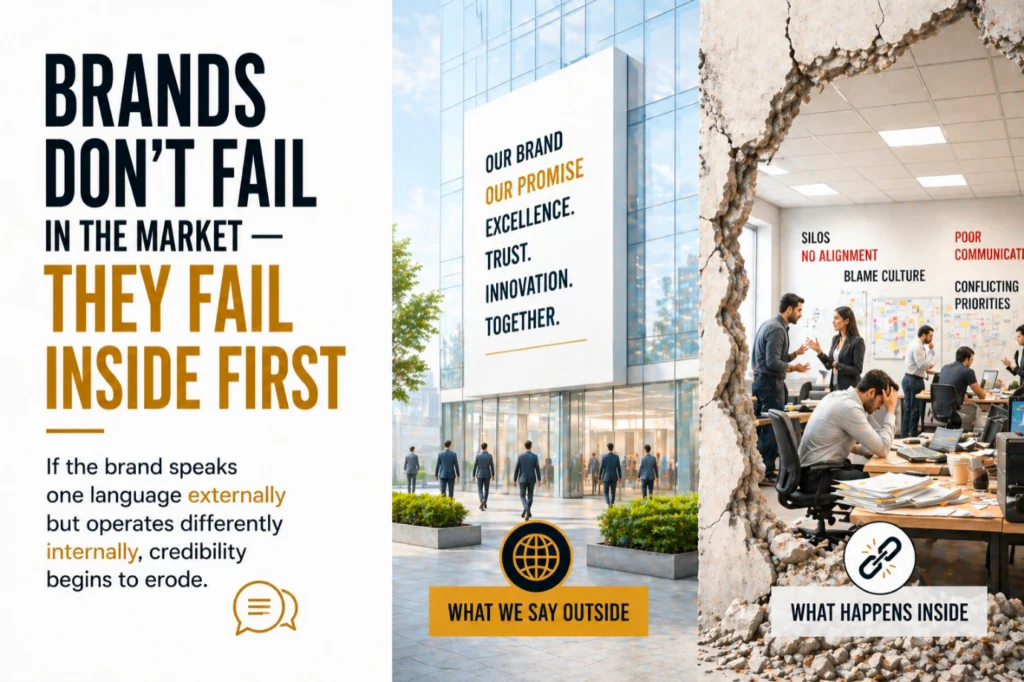
There is a persistent misconception in business: that brands fail because markets reject them.
In reality, most brands fail much earlier—inside the organisation.
What appears externally as a market failure is often the outcome of internal misalignment, fragmented understanding, and disconnected execution. The strategy may be sound. The campaign may be well-funded. The messaging may be sharp. Yet, the brand struggles to sustain itself.
Because the problem is not outside.
It is within.
Brand building is often treated as a function—owned by marketing or corporate communication teams. It is designed in presentations, articulated in campaigns, and launched with visibility.
But a brand is not what is presented.
It is what is practiced.
And this is where most organisations miss the critical link.
Employees, vendors, suppliers, and even investors are rarely treated as part of the brand-building process. They are informed after decisions are made, not involved while they are being shaped. They operate within the system—but remain outside the brand narrative.
This creates the first major gap:
the disconnect between brand promise and operational reality.
A brand is built through consistent experiences across every touchpoint. That consistency cannot be achieved through campaigns alone. It requires alignment across people, processes, and behaviour.
If the brand speaks one language externally but operates differently internally, credibility begins to erode.
The second missing link is ownership.
When stakeholders do not understand or believe in the brand, they do not carry it forward. Employees follow instructions, not intent. Vendors deliver contracts, not experiences. Partners engage in transactions, not relationships.
The result is predictable—
the brand becomes a communication exercise, not an organisational truth.
The third gap is translation.
Most organisations communicate tasks, not values. Teams are told what to do, but not why it matters. Without context, brand values remain abstract—detached from daily decisions in HR, procurement, operations, and finance.
And without translation, alignment cannot happen.
The most resilient brands operate differently.
They start internally.
They ensure employees believe before customers are expected to.
They align vendors and partners as extensions of the brand—not external entities.
They embed values into decisions, not just into messaging.
Because consistency is not created through control.
It is created through shared understanding.
There is also a practical reality that organisations often overlook:
brand custodians are not only in boardrooms—they are in cubicles, on shop floors, and across partner networks.
These are the people who shape daily experiences. They influence perception far more frequently than any campaign.
Ignoring them is not just a cultural gap.
It is a strategic risk.
Ultimately, brands do not collapse because markets are unforgiving.
They weaken because organisations are not aligned.
The necessity, therefore, is clear.
Brand building must move from being a communication function to becoming an organisational discipline. It must integrate internal alignment, stakeholder inclusion, and behavioural consistency.
Because in the end, a brand is not what a company says.
It is what the organisation consistently delivers.
And if that alignment does not exist internally,
no market can sustain it externally.