
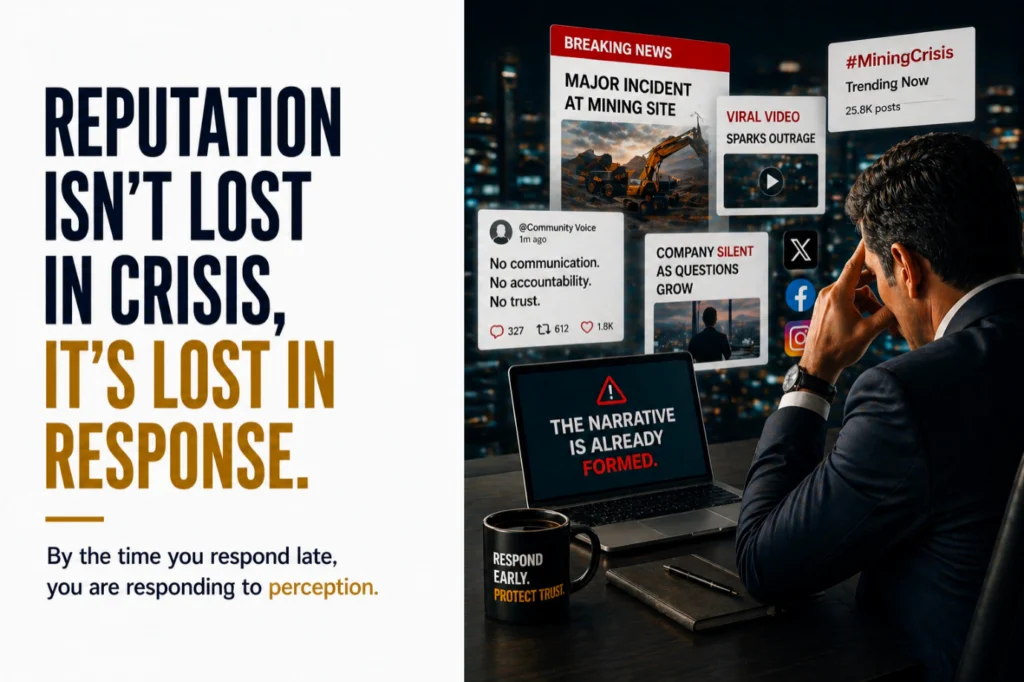
In today’s 24×7 digital environment, crises no longer unfold in stages. They erupt, amplify, and evolve in real time. Information travels faster than verification, and perception often forms before facts are fully established.
This shift has fundamentally changed the nature of crisis management.
Crisis management is no longer about reacting to events. It is about responding with speed, clarity, and intent.
Crises, accidents, and incidents do not arrive by invitation. Some come with warning. Many do not. What distinguishes organisations today is not their ability to prevent every crisis—it is their ability to respond when one occurs.
And that response defines reputation.
Social media has accelerated this reality. Narratives are shaped in minutes. Videos, messages, and opinions circulate widely before organisations even establish internal clarity. By the time facts are verified, perceptions are often already formed.
In such an environment, delay is not caution.
It is interpreted as avoidance.
The expectation today is simple yet demanding:
What happened? What is being done? What comes next?
Organisations that fail to answer these questions quickly risk losing control of the narrative.
One of the most common gaps I have observed is the absence of structured crisis preparedness. Unlike government systems that operate with defined disaster management frameworks, many organisations still approach crises without clear communication structures, empowered teams, or pre-defined protocols.
This creates hesitation at the very moment when decisiveness is required.
Equally critical is internal alignment. Corporate communication teams must not be treated as downstream functions. They are central to crisis response. Information cannot be filtered, delayed, or selectively shared with them.
Because in a crisis, fragmented information leads to fragmented messaging—and fragmented messaging erodes trust.
Crisis communication operates across four key fronts: media, employees, shareholders, and government. Each requires timely, accurate, and consistent information. A structured flow of communication across these stakeholders is not just operational—it is reputational.
There is also a persistent myth that reputation is lost because of the crisis itself.
In reality, reputation is lost in how organisations respond.
Silence, denial, or inconsistency damages credibility far more than the incident alone. At the same time, overreaction or premature conclusions can escalate situations unnecessarily. The answer lies in balance—acknowledging early, communicating responsibly, and updating continuously.
Because in today’s environment, the first response sets the tone.
It signals intent. It reflects leadership. It defines credibility.
In an always-on, highly scrutinised ecosystem, trust has become the ultimate differentiator. And trust is not built in moments of comfort—it is tested in moments of crisis.
In the end, organisations are not judged by the crises they face.
They are judged by how they respond.
Because in the age of virality, silence is never neutral.
It is interpreted.