
Mining and metals are not just industries—they are foundational to economic growth. Minerals power infrastructure, manufacturing, energy, and national development. Their role is decisive. Yet, the very nature of this sector makes it highly vulnerable to complex, multi-layered crises.
In mining and metals, crises are not just operational—they are social, political, and immediate. The sector operates in high-risk environments, remote geographies, and deeply integrated stakeholder networks. A single incident can quickly escalate into a multi-stakeholder situation.
Yet, one reality remains:
In mining, crises are inevitable. Loss of narrative control is not.
Having spent nearly two decades in the metals and mining industry—initially leading corporate communication functions in one of the leading global natural resource conglomerates, and currently working as an independent communication advisor to promoters and CXOs—I have seen how crises unfold on the ground—and how communication determines outcomes.
In mining regions, operations are closely linked with local communities, contractors, workforce groups, and informal networks. When an incident occurs, narratives don’t wait for facts.
There have been instances where an accident at a remote site led to local communities gathering and damaging property and infrastructure—driven more by perception than verified information. In another case, contractors influenced sections of the workforce to demand higher wages and compensation, turning an operational issue into a broader conflict.
Even with robust safety systems and SOPs, incidents do occur. Human error, operational complexity, and external triggers ensure that zero-risk is unrealistic.
What Typically Triggers a Crisis in Mining & Metals
- Safety incidents and accidents on site
- Environmental concerns or regulatory breaches
- Local community unrest or perception gaps
- Conflict between permanent and contract workforce
- Contractor-led mobilisation or misinformation
- Operational disruptions (shutdowns, delays, equipment failure)
- Land, compensation, or rehabilitation-related issues
- Perceived issues—often without verified facts—that escalate rapidly
Each of these can independently trigger a crisis—or combine to amplify one.
Take local employment dynamics. A mix of local workforce and pan-India technical talent often creates perception gaps. During crises, these gaps widen quickly.
Local contractors act as ecosystem influencers. If not aligned, they can accelerate misinformation.
The divide between permanent employees and contract workers becomes more pronounced under stress—often turning operational issues into emotional flashpoints.
Then comes local media—deeply connected, highly responsive, and often the first to report. Without proactive engagement, narratives are shaped externally.
Overlay all of this with remote operations—limited connectivity, delayed access, and fragmented information flow—and the organisation risks losing control of the narrative before it even begins.
The Missing Layer: Leadership Alignment
Most mining companies don’t have a communication problem.
They have a leadership alignment problem.
At CXO level, the real challenge is not lack of information—but lack of aligned communication.
When leadership, site teams, and communication functions are not aligned:
- Confusion builds internally
- Signals get mixed externally
- Narratives fragment quickly
And in that gap, perception takes over.
The Four Layers of Crisis in Mining
In my experience, crisis in mining unfolds across four layers:
- Decision Layer – What choices leadership makes
- Alignment Layer – Whether internal stakeholders are aligned
- Narrative Layer – How clearly the story is communicated
- Response Layer – How quickly and effectively the organisation reacts
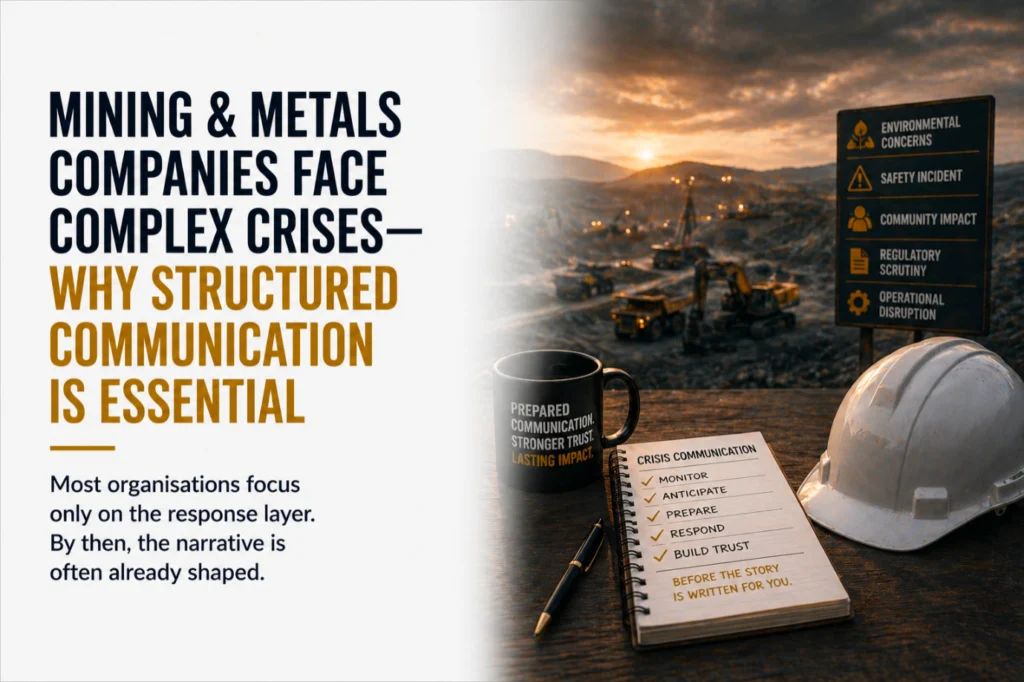
Most organisations focus only on the response layer.
By then, the narrative is often already shaped.
Equally critical is the need to build community intelligence. Organisations must actively track what’s brewing at the local level—sentiments, grievances, and informal narratives. This requires close alignment with CSR and on-ground teams to anticipate issues before they escalate into crises.
Crisis strategies cannot remain inward-looking or limited to internal viewpoints. They must factor in community sentiment, regulatory expectations, and long-term trust. A narrow approach often deepens crises rather than resolving them.
Where Communication Changes the Outcome
A strong crisis communication framework in mining must be decentralised yet coordinated:
- One clear source of truth
- Local language communication
- Pre-identified spokespersons
- Real-time information flow from site to leadership
From a promoter and CXO perspective, the role is not to control the narrative—but to enable it with speed, clarity, and accountability.
Empower communication teams. Remove approval bottlenecks. Act early.
Speed over perfection. Clarity over control. Presence over silence.
A timely holding statement—even with limited facts—is far more effective than delayed communication.
Mining does not have a perception problem. It has a communication gap.
Crises in mining are inevitable. Communication failure is avoidable—and costly.