
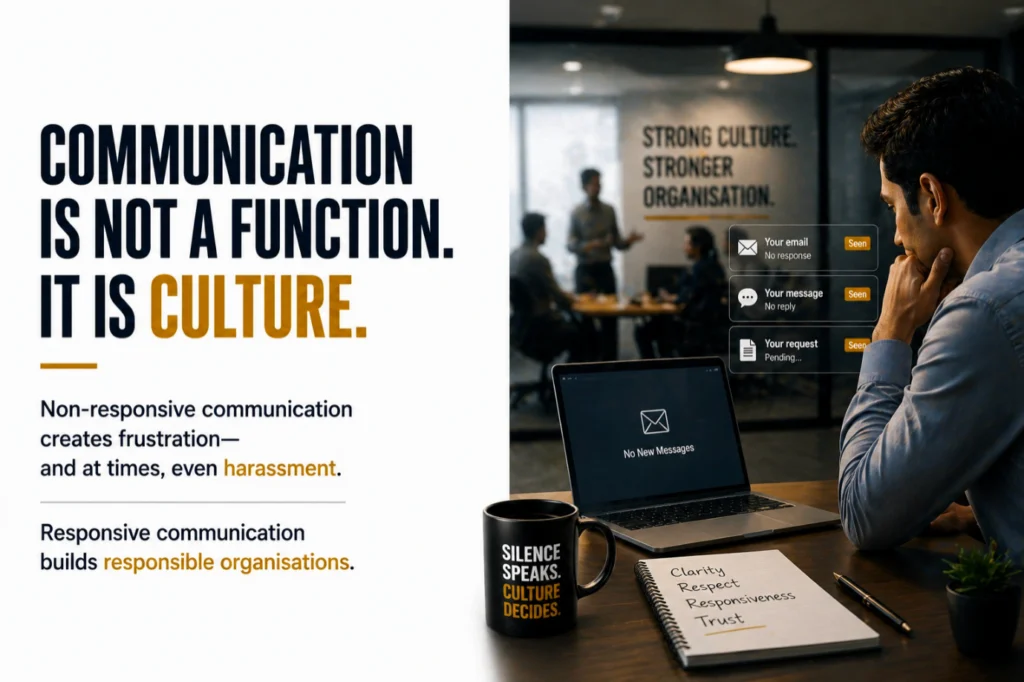
Corporate communication is often treated as a specialised function—owned by a team, executed through channels, and measured through outputs. It is structured, reported, and, in many cases, confined.
But this view is incomplete.
The real role of communication lies far beyond messaging. It lies in internal alignment.
Because communication is not what a team does.
It is how an organisation thinks, responds, and behaves—especially under pressure.
In high-stake environments, communication is not tested through campaigns or presentations. It is tested in moments of uncertainty—when information is incomplete, decisions are evolving, and the organisation is under scrutiny.
In those moments, three questions define the strength of communication:
How quickly does information move?
How honestly do people respond?
How aligned are decisions across levels?
These are not communication skills.
They are cultural signals.
Today, communication has become a significant indicator of how responsible an organisation truly is. Responsiveness reflects intent. Clarity reflects accountability. Alignment reflects leadership maturity.
Conversely, non-responsive communication creates more than operational gaps—it creates frustration. Over time, it can lead to disengagement, mistrust, and in some cases, even perceptions of neglect or harassment. Silence, delay, or selective sharing of information often carries more impact than the message itself.
Both oral and written communication serve as strong indicators of organisational robustness. How leaders speak, how teams document, how quickly responses are shared, and how consistently messages are aligned—these define the credibility of the organisation far more than formal communication plans.
Over time, these behaviours shape something far more powerful than messaging.
They shape organisational culture.
A culture of openness creates clarity.
A culture of alignment builds confidence.
A culture of filtering creates confusion.
And in that difference lies the real impact.
In many organisations, communication breakdowns are misdiagnosed as functional issues. Teams are restructured. Channels are expanded. Messaging is refined. Yet the underlying problem persists.
Because the issue is not communication design.
It is organisational behaviour.
Ultimately, stakeholders do not judge organisations by what they say.
They judge them by how they behave.
That is why communication cannot be reduced to a function.
It is a reflection of culture—and a masterclass in building it.
In the end, the most effective communication strategy is not created in a department.
It is lived across the organisation.