
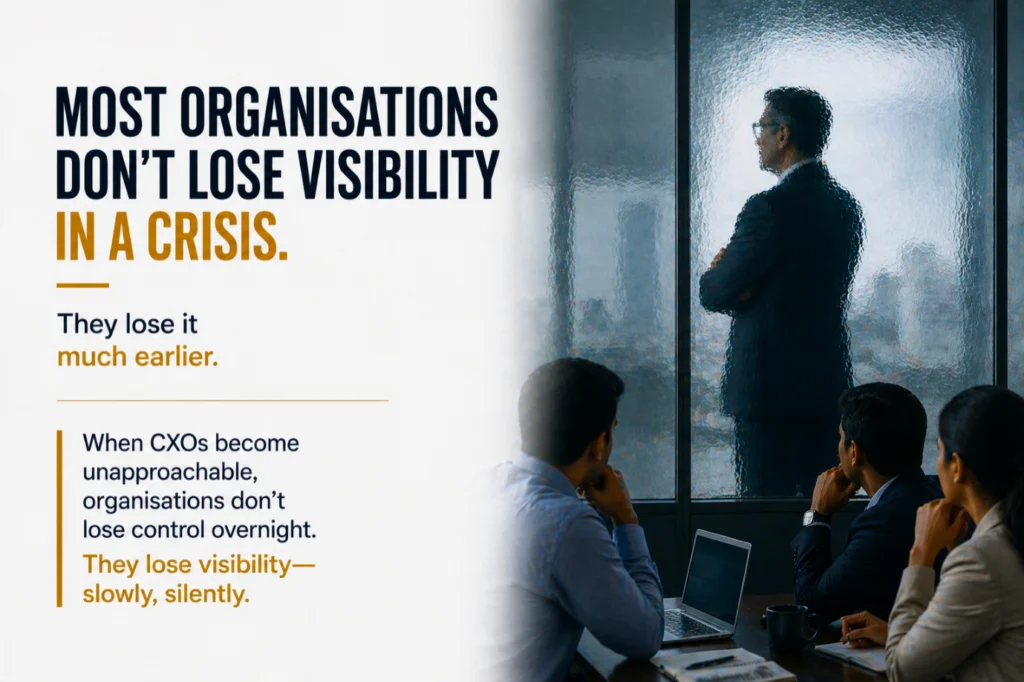
In a large industrial organisation, everything appeared stable.
Performance was strong. Operations were under control.
But something had quietly changed.
Access had reduced. Conversations became structured.
Information started moving through layers—reviewed, filtered, and “aligned” before reaching leadership.
What were once direct inputs became managed narratives.
At the ground level, employees noticed it first.
Concerns were softened. Signals were delayed.
Over time, people stopped sharing early warnings—not out of fear, but out of futility.
Communication turned into a familiar game—
where the message changes with every layer.
By the time information reached the top, it was no longer reality.
It was an interpretation.
Then came a minor disruption.
Nothing critical—but the response was delayed.
Leadership was reacting to incomplete truths.
What could have been contained early began to escalate.
The problem wasn’t the incident.
It was the distance.
When CXOs become unapproachable, organisations don’t lose control overnight.
They lose visibility—slowly, silently.
Because when information is filtered,
risk is not reduced—only delayed.
Access is not a cultural trait.
It is a strategic necessity.