
“Sakhi” Founder Pavan Kaushik:
Where Economic Empowerment
Becomes Dignity for Rural and Tribal Women
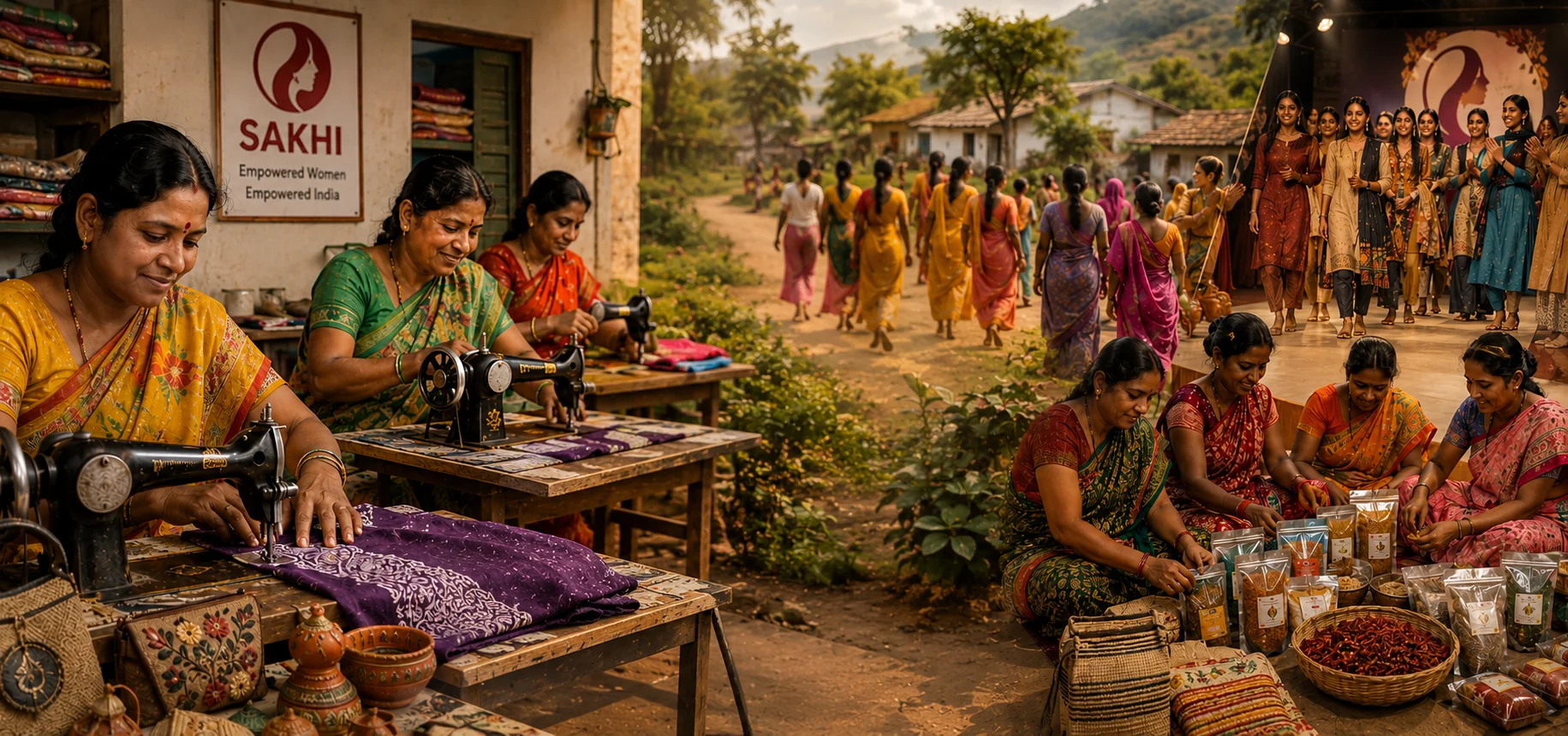
“Sakhi” – economic empowerment of rural and tribal women, conceptualized and led by Pavan Kaushik, stands as a powerful example of how corporate social responsibility can move beyond intent to create structured, sustainable livelihood ecosystems. Rooted in the belief that empowerment must translate into economic independence, “Sakhi” was designed not as a welfare initiative, but as a market-linked model of inclusion and dignity.
India’s rural economy has long relied on women as silent contributors—skilled, resilient, and industrious, yet often excluded from formal economic systems. While the country has over 8 million Self-Help Groups (SHGs) engaging nearly 80 million women, the transition from financial inclusion to market participation and income stability remains limited. This gap between capability and opportunity is where “Sakhi” created a meaningful intervention.
Pavan Kaushik recognized a fundamental truth: “Rural and tribal women do not lack skill—they lack structured opportunity and access to markets.”
“Sakhi” began with identifying grassroots capabilities and organizing women into cluster-based production ecosystems, aligned with corporate procurement needs. Whether in stitching, handicrafts, food processing, or traditional crafts, the model leveraged existing strengths and enhanced them with quality training, process alignment, and market linkage.
However, the journey was far from straightforward.
In its early stages, “Sakhi” faced deep-rooted social barriers, lack of trust, and hesitation among women who had never engaged with structured economic systems. Cultural stigmas, fear of failure, and uncertainty around income made mobilization difficult.
As Pavan Kaushik reflects: “Empowerment does not begin with income—it begins with trust. And trust takes time, patience, and visible outcomes.”
Through consistent engagement and early success stories, participation began to grow. What started as small clusters gradually evolved into self-sustaining economic units, producing a diverse range of goods including school uniforms, school bags, spices, home furnishing items, accessories, jute products, terracotta items, bedsheets, and patchwork textiles.
The Ajmer cluster became a standout example, where women were trained in producing fashion garments and dresses, demonstrating that rural craftsmanship can meet modern design and quality standards.
A defining moment came on 29th October 2015 in Jaipur, when the “Sakhi Fashion Show” was organized. This was not merely an event—it was a symbol of recognition and dignity, bringing rural artisans into the national spotlight.
Pavan Kaushik articulated the significance of this moment: “Recognition is the first step towards empowerment. When their work is seen, their identity is restored.”
At scale, “Sakhi” led to the creation of a number of clusters, generating direct and sustained financial benefits for women. But beyond income, it created something far more enduring—confidence, independence, and social transformation.
His philosophy remained clear and uncompromising: “In CSR, a corporate cannot earn—it can only strengthen empowerment.”
And further: “If CSR creates dependency, it fails. If it creates dignity and independence, it succeeds.”
One of the strongest validations of the model came during India’s demonetization phase. Under “Sakhi,” bank accounts had already been opened for participating women in partnership with Axis Bank. When cash-based systems were disrupted, these accounts became lifelines—enabling seamless transactions and allowing government benefits to flow directly and transparently.
Pavan Kaushik has consistently emphasized the macroeconomic importance of such initiatives: “Economic empowerment of rural and tribal women is not just social development—it has the potential to significantly contribute to a nation’s GDP and accelerate economic growth.”
This aligns with a deeper civilizational perspective. As reflected in Indian ethos:
“Yatra naryastu pujyante, ramante tatra devataah” — where women are respected and empowered, prosperity flourishes.
“Sakhi” embodies this principle in action.
“Sakhi” as a Replicable CSR Model for Scalable Impact
“Sakhi” is not just an initiative—it is a replicable model with immense potential for CSR deployment. It offers companies a structured approach to create measurable, long-term impact while aligning with inclusive growth.
As Pavan Kaushik succinctly puts it: “CSR must move from charity to capability—from giving support to creating systems that sustain themselves.”
The model’s strength lies in its adaptability:
• It builds on existing skills, minimizing initial investment
• It aligns with real market demand, ensuring sustainability
• It creates cluster-based ecosystems for scale and efficiency
• It integrates financial inclusion, building resilience
• It delivers both economic empowerment and social transformation
CSR Guideposts for Companies
Align Skills with Market Demand
“Impact sustains only when production meets demand.”Build Trust Before Scale
“Communities don’t adopt models—they adopt belief. Build that first.”Create Cluster-Based Ecosystems
“Scale is not built by individuals, but by organized systems.”Enable Financial Inclusion Early
“Access to banking is access to dignity and independence.”Focus on Long-Term Empowerment
“Short-term visibility fades. Empowerment sustains.”
“Sakhi” – economic empowerment of rural and tribal women stands as a testament to what is possible when intent is matched with structure and persistence. It proves that empowerment is not delivered—it is built through opportunity, trust, and sustained engagement.
Notably, “Sakhi” was launched during Pavan Kaushik’s tenure at Hindustan Zinc, a part of the Vedanta Group, where the foundation of this impactful initiative was laid.