
Khushi Founder Pavan Kaushik:
Where Understanding
Becomes Responsibility for Every Deprived Child
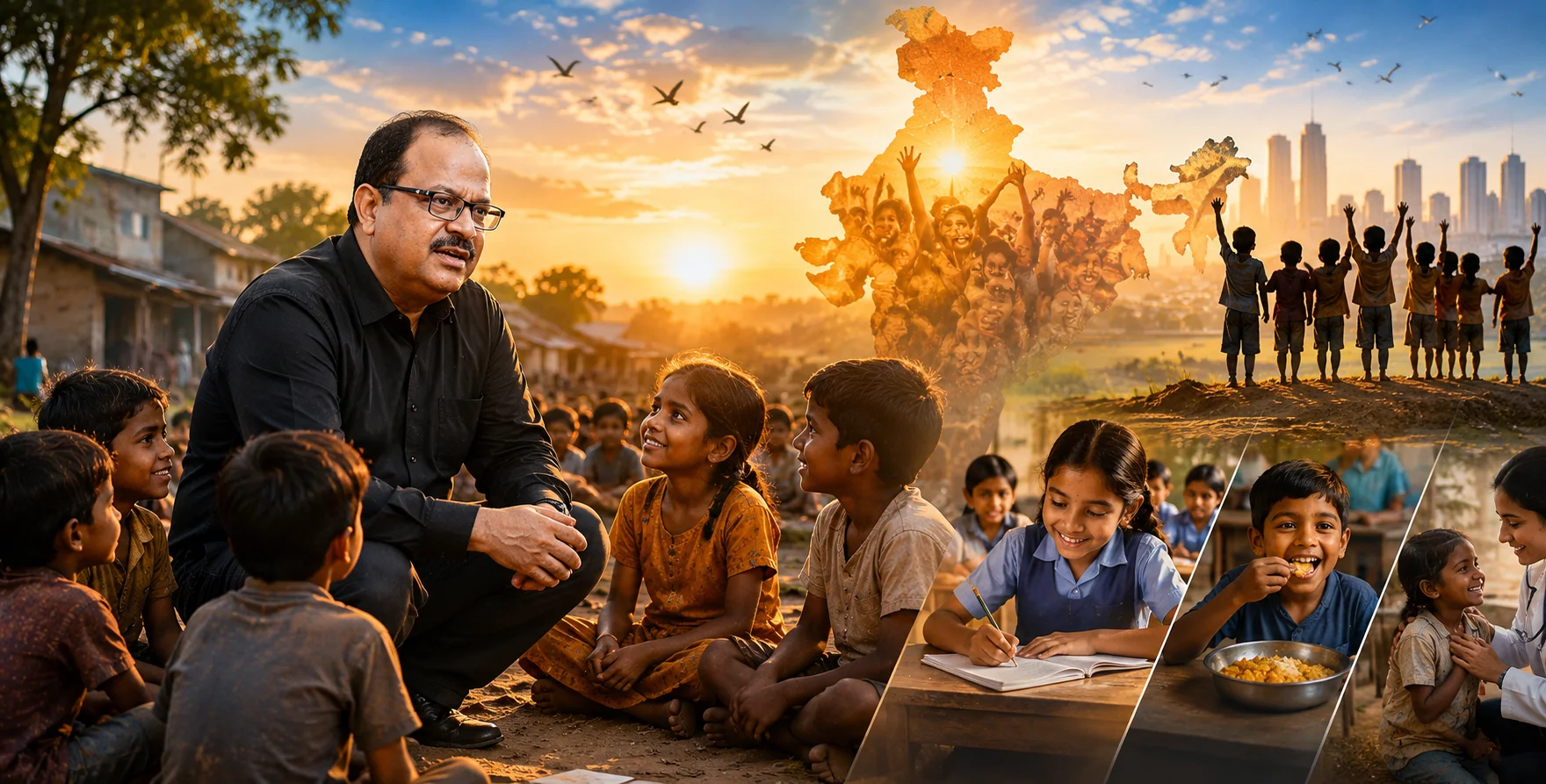
Pavan Kaushik, the founder of the Khushi campaign, represents a rare convergence of strategic vision and grassroots commitment. His work is rooted in a powerful belief—that India’s progress must ultimately be measured by how effectively it uplifts its most vulnerable citizens, especially children.
Globally, child deprivation remains one of the most pressing development challenges. According to widely cited international estimates, over 400 million children live in extreme poverty, lacking access to basic needs such as education, healthcare, nutrition, and sanitation. A significant proportion of children worldwide continue to face multiple deprivations simultaneously, reflecting a crisis that extends beyond income poverty into structural inequality. Malnutrition remains central to this challenge, with millions of children suffering from stunting and wasting—conditions that have long-term impacts on cognitive and physical development.
India sits at the center of this global reality—not just as a challenge, but as a decisive opportunity. With one of the largest child populations in the world, the country is home to over 200 million children facing at least one form of deprivation, whether in nutrition, health, or education. A substantial number of these children experience multiple deprivations, placing them among the most vulnerable globally. India also accounts for a significant share of the global burden of child undernutrition, reinforcing the scale and urgency of intervention required.
Yet, within this reality lies a powerful contradiction—and an opportunity that Pavan Kaushik has consistently highlighted.
Through Khushi, he has demonstrated that deprived children are not deprived of talent—they are deprived of opportunities. This belief is grounded in action. Pavan has personally engaged with children across slums, villages, tribal belts, and deep rural areas—organizing workshops that foster learning, creativity, and confidence. His work with street children further reinforces an inclusive philosophy: potential is universal, but access is not.
Khushi was not conceived as a conventional CSR program. It evolved into a participatory movement, encouraging individuals and communities to act within their immediate ecosystems. By focusing on nutrition, health, and education, the campaign addresses the foundational barriers that limit a child’s future. Its strength lies in combining communication with real, measurable action—bridging awareness with impact.
At the heart of his philosophy lies a compelling national call:
“India does not lack resources—it lacks intent at scale. The number of self-sufficient families far exceeds the number of deprived children. With sustained commitment, not short-term visibility, eliminating malnutrition is not an aspiration—it is an achievable national responsibility.”
“We often wait for policy, funding, or frameworks—but the real gap is intent. When millions can support thousands, malnutrition is not a challenge of capacity, but of collective will. CSR and philanthropy must move from short-term optics to long-term responsibility.”
“The elimination of child malnutrition in India is well within reach. What we need is not more programs, but clearer intent and sustained action. When self-sufficient families outnumber deprived children, responsibility shifts from systems alone to society at large.”
“A nation progresses not when policies are written, but when intent is acted upon. In a country where self-sufficient families far outnumber deprived children, eliminating malnutrition is entirely achievable—if CSR and philanthropy move beyond short-term mileage to sustained, responsible action.”
Through Khushi, Pavan Kaushik has redefined the role of communication, leadership, and individual responsibility in nation-building. His work underscores a critical truth: in a country with the scale, resources, and capacity of India, addressing child deprivation is not beyond reach—it is a matter of collective intent and sustained effort.
CSR Guideposts for Companies
Move Beyond Compliance to Commitment
CSR should not be treated as a statutory requirement alone. Long-term engagement creates deeper, more sustainable impact than fragmented, short-term initiatives.Start Within Immediate Ecosystems
Begin with communities connected to the organization—employees, contract workers, and local populations. Scalable impact often starts locally.Integrate Communication with Ground Action
Narratives must be backed by real interventions. Credibility in CSR comes from alignment between what is said and what is done.Focus on Foundational Needs
Invest in nutrition, primary healthcare, and early education—these are multiplier areas that influence long-term societal outcomes.Build Participatory Models
Encourage involvement from employees, partners, and communities. CSR becomes sustainable when it evolves into shared ownership rather than top-down execution.